Bidding and Budgeting: How to Set the Right Bid for Your Paid Ads Campaign
How much money are you going to spend on marketing this year? No matter the amount, you probably want to use it wisely and get the best possible results.
That’s why paid ads have become so popular. You only pay when your ads work — it’s a smart and flexible way to promote your business and see real results, even with a small budget.
But just placing a bid isn’t enough. To get the most from your money, you need the right strategy.
In this article, we’ll explain how the bidding model works, what types of bids exist, and share simple tips to help you manage your budget effectively.
Bidding and Budget: Basic Principles
Before we move on to practical tips, let’s quickly go over the basic concepts of bids and budgets — understanding them will make the next steps much easier.
What Is Bidding and Why Do We Use It
Bidding is the process of competing for ad placements in an online auction. Each time a user visits a site, advertisers place their bids, and the highest one wins the spot.
Here is more about auctions:

Besides the fact that auctions help determine who wins the available positions, bidding is often more affordable than set pricing. The price of each ad may vary depending on competition, demand, the vertical you choose, and time of day. Marketers can choose the type of device, location, and time for their ads to show up, which may end up getting them more bang for their buck.
At the same time, remember bidding means you’ll only pay for the ads that people see or interact with. This means you can manage all aspects of your marketing spend, for instance, pausing and resuming your campaign depending on your budget.
What is a budget, and how do you manage it
Your budget is the amount of money you’ll invest in your marketing efforts. In most cases, the size of your budget will directly impact the performance of your campaign. That being said, savvy marketers can work wonders with small budgets, as long as they make the right moves.
There are two main types of budgets you’ll have to monitor while your campaign is running. These are:
- Daily Budget: Tells you the maximum amount of money you’re willing to spend on your marketing campaign on a daily basis.
- Total Campaign Budget: As you can imagine, it’s the entire budget you’ve set for the duration of your campaign. If you’re launching an ongoing campaign, this number will likely increase over time, so many companies choose to set yearly budgets as well.
Read more:

Theoretically speaking, bigger budgets should result in more efficient campaigns because they allow you to place higher bids and get a wider reach. At the same time, you can keep your ads running for longer periods of time or simply create more campaigns with a bigger budget.
Keep in mind that a big budget doesn’t necessarily mean your campaign will be a success. On the other hand, because you’re investing more money, you have to be very careful. Instead of carelessly burning through your budget, try to segment it into different campaigns and work them individually.
How to spread your budget
There’s a simple rule that says: spend 70% of your budget on things that bring you direct profit, and the other 30% on building your brand — making people know and trust you.
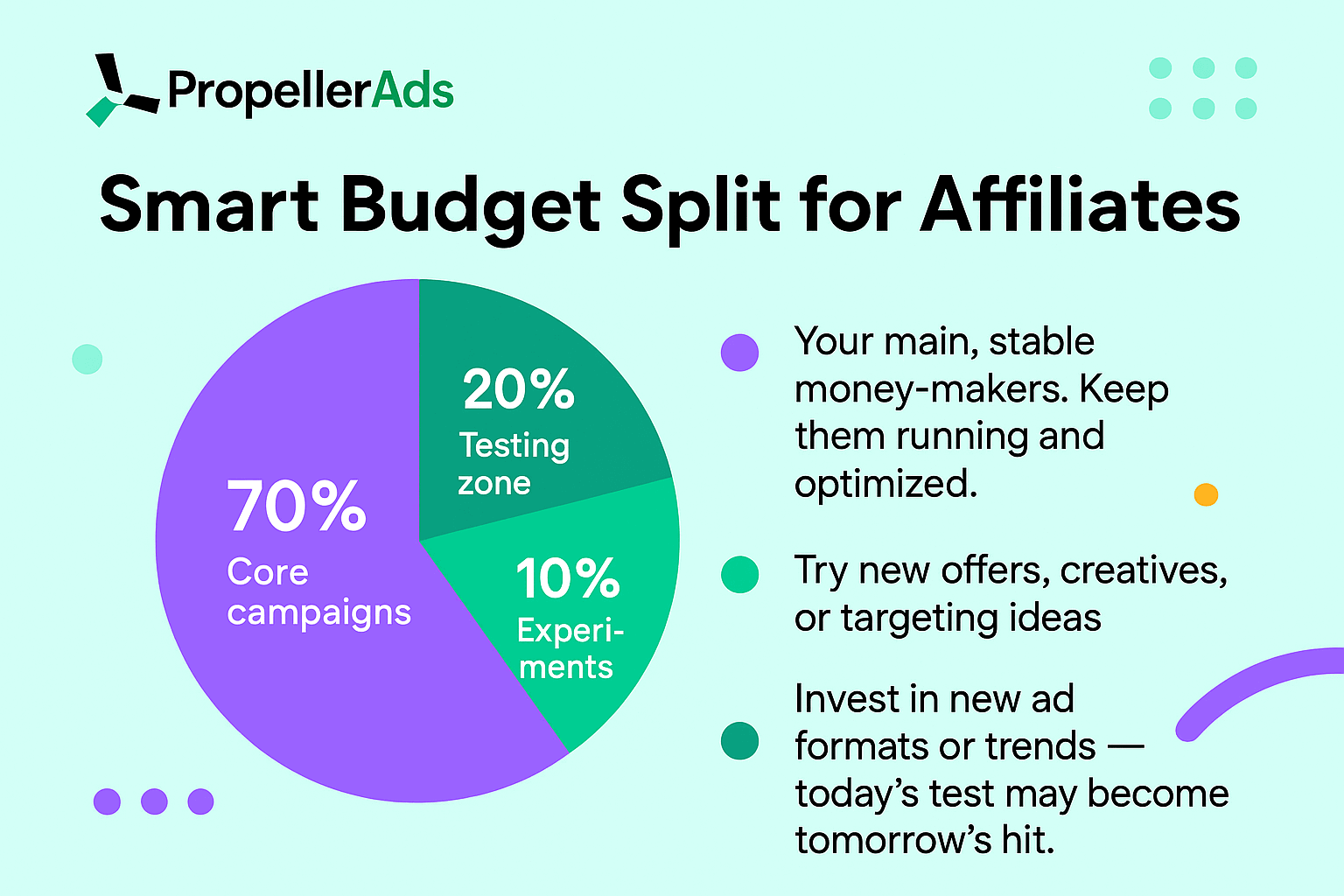
Another popular rule is the 70:20:10 formula:
Bidding Models: What Are They?
There are different bidding models you can choose from when running a performance campaign. Each one has its own set of benefits and setbacks, so you need to look at the three structures and choose the best for your case.
- Cost-Per-Action – CPA. In this structure, advertisers are only required to pay when users take a precise step, like filling out a contact form or providing a credit card number.
- Cost-Per-Click – CPC. As the name indicates, advertisers are required to pay every time a user clicks on their ad, regardless of what action is taken next.
- Cost-Per-Mille (1000 Impressions) – CPM. Effective for almost any campaign goal, advertisers pay every time their ad is displayed 1000 times.
Besides, there are three exclusive bidding models you’ll find at PropellerAds, which use smart automation and real-time optimization to help you get better results with less effort. Each of them adapts to your campaign goals and traffic type.
- CPA Goal. CPA Goal is an automated bidding model for Push, Onclick, and Interstitial ads that helps you get conversions at your chosen price. It uses machine learning to find and prioritize traffic segments that are most likely to convert.
The system automatically adjusts bids, focusing your budget on the best-performing zones and freezing weak ones. As a result, your campaigns get more high-quality traffic, stable CPA, and less manual work.
- SmartCPM. SmartCPM is a bidding model from PropellerAds that helps advertisers pay a fair price for each ad placement automatically. You set your maximum CPM bid, and the system adjusts the actual price based on competition — usually lower than your max.
It lets you pay less for weak zones and get more traffic from high-performing ones, all managed automatically 24/7. As a result, you save budget, avoid overpaying, and keep full control over each zone’s performance.
- SmartCPC. SmartCPC is a new bidding model from PropellerAds for Push and In-Page Push campaigns. It automatically manages bids across zones, so you don’t have to optimize them manually.
You just set your maximum CPC bid, and the system adjusts prices to get cheaper traffic where possible. As a result, you get the same high-quality traffic — but 20–30% cheaper than with regular CPC.
What You Have to Keep In Mind When Choosing a Bid
There’s no single perfect way to build a winning bidding strategy. The best approach is to make your own plan that fits your goals and takes all key factors into account.

To build a solid bidding strategy, remember to look at your:
| What | Why |
| Marketing Goal | You might need to boost sales, advertise new products, or create brand awareness. Take your goals into consideration as they will help you choose the best bidding model and set the right bid. |
| Product Type and Availability | The products you offer will help determine aspects like your target location and ad schedule. Always make sure they are available for purchase at the time and in the area, the ads are displayed. |
| Ad Formats | Popunder ads, Interstitial ads, Push Notifications, In-Page Push, Survey Exit, or Telegram Mini App Ads – every format can work differently depending on your offers and goals. You can significantly reduce or increase your spend depending on the type you choose. |
| Overall Budget | As we mentioned before, the size of your budget may affect the reach and performance of your campaign. Remember to spend responsibly and keep a close eye on any unexpended surges. |
| Optimization | All efficient digital campaigns need to be optimized and adjusted for better performance. Once you have collected enough information, optimizing your budget to reduce costs or improve performance will be critical to your success. |
| Devices You Want to Target | Mobile and desktop campaigns cost differently. For example, mobile traffic is usually cheaper, but it might be trickier to make users convert sometimes. So check where your audience converts better and focus your budget there. |
| Target Audience’s Location | Ad prices change depending on the area you’re targeting. Marketers working with small budgets can start targeting areas where ads are more affordable and eventually move into higher-stakes markets. |
How to Set The Right Bid
So, now that we’ve covered the basic elements you always need to remember, let’s take a look at setting the right bid.
As auction prices depend on your industry, location, and other factors we’ve mentioned before, we won’t give you specific values. Instead, we’ll share tips that help you come up with a budget based on your specific situation.
1. Check The Traffic Estimator
At PropellerAds, you have a convenient Traffic Estimator – a built-in tool that shows how much traffic is available for your chosen targeting — GEO, device, OS, or operator. It helps you see potential reach and choose the right bid before launching a campaign. In short, it’s your way to predict traffic volume and quality and spend your budget wisely.
2. Choose a Starting Point
Once you’ve estimated your bids, it’s time to actually set each one. Generally speaking, you can set bids for your entire campaign that work as a default setting. You also have to set individual bids for each ad group and individual ad.
It’s likely that the default value will not suit all ad groups or ads, so you should take the time to set these individually. Plus, you’ll already know what you’re doing when it’s time to optimize your campaign.
There are generally two approaches you can take to set a starting point:
- High to Low. If you have a big enough budget, you can start off with high bids. This will improve their chances of getting noticed and may yield results faster. In this model, one of your main goals will be to bring down your costs while maintaining performance.
- Low to High. If you have smaller budgets, begin with lower bids. If you see that your bids are enough after testing, you increase them to scale your campaign.
3. Testing Phase
So, your campaign is running, but the results are not impressive yet. Don’t worry — this is part of the testing phase.
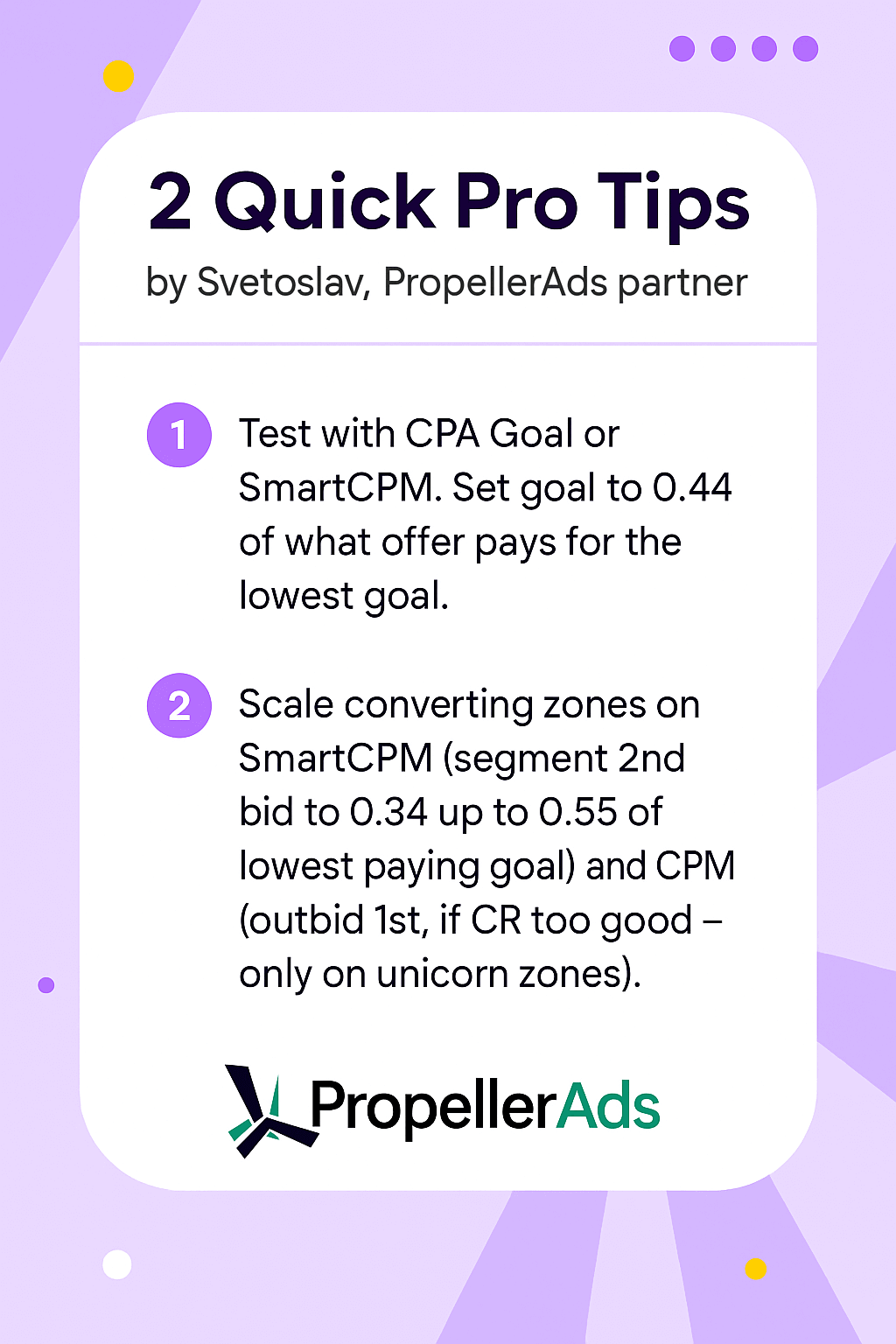
To understand if your bid is too low, use the Traffic Estimator: it shows how much traffic you can reach at each bid level. PropellerAds Account Managers recommend adding about +10% to the current top bid you see at the Traffic Estimator.
As one of PropellerAds’ partners and blog authors, Ettore Spinelli, once said in the PropellerAds chat –
‘It depends on how profitable your campaign is. If you’re doing 200% ROI, just constantly raise the bid :)’
4. Optimizing your bids
Once you get some information about your campaign, you can optimize and scale.

As a general rule of thumb, you can start optimizing CPA and CPC campaigns after 200 clicks or more. For CPM campaigns, getting to 5,000 displays should be a nice starting point when you can change the bid.
Static bidding can cost you a significant amount of money in the long run. Try to change your bids regularly and see how your campaign reacts. For example, if your CTR or conversions drop, your bid might be too low. If your spending grows too fast without better results, it might be too high.

Bidding And Budget Checklist for Media Buyers
- Look at your statistics. Your statistics will reveal areas of improvement that may reduce your costs. For instance, you might want to increase the bids on certain device types and thus improve your numbers and lower your costs.
- Play around with your bids frequently. Once you check your stats, adjust your bids accordingly if you notice any changes that might require attention – for example, a drop in CTR, fewer conversions, or increased competition.
- Check your daily spend throughout the day. Keeping track of your daily spending is the best way to control your budget. You can pause and resume your campaign and even increase your bids on the spot, depending on that day’s performance.
- Keep your campaigns separate. Creating separate campaigns helps you stay organized. It also lets you make changes for each location or device, which you can’t do if you run only one campaign.
- Deliver ads at the right time. Many media buyers leave money on the table because they let their campaigns run around the clock. While this setup may work for some, most advertisers should focus on the hours when their audience is actually online. This helps you spend your budget more effectively, showing ads only at the best times instead of wasting money when users are inactive.
Ready to put the theory into practice? Check your existing campaigns’ budget or create a new financial strategy for your ad activities!
Join our Telegram for more insights and share your ideas with fellow-affiliates!