How Predictive AI Changes iGaming Traffic and Why Media Buyers Should Care

Yeah, we know, AI is the buzzword you’ve heard around 500 times this week. But don’t rush to close this piece: we prepared something spicy that almost nobody’s talking about.
Look: over the past several years, the iGaming industry has begun shifting from manual personalization to AI predictive engagement.
These are systems that predict player behavior, manage risk, and minimize fraud. The most exciting part is that it’s not just a theory: the biggest operators, such as Entain, Kindred, Flutter, and Betsson, are already adapting their algorithms with predictive AI.
Okay, so what? It means this shift is about to hit media buyers directly. Predictive AI doesn’t just evaluate players, but also your traffic. Is this good or bad news?
Read on to find out.
Predictive Behavior Models: What Do They Do?
Predictive behavior models are AI systems that learn from millions of player actions – clicks, session length, spend size changes, browsing patterns, time-of-day activity, and use this data to forecast what a player is likely to do next.
Here is what they can do:

Predict Problem Gaming and Player Churn
This seems to be the most mature branch of predictive AI so far: they successfully track user behavior patterns and predict various outcomes or probabilities:
- How likely a player is to return or churn
- Will a player show too risky and wild gaming
- Are there any harmful patterns
- How often does a player use bonuses
- What’s the overall player’s engagement
Here are some real-world examples:
- Entain uses an AI system called Advanced Responsibility & Care (ARC). It monitors players’ behavior in real-time, and if someone starts playing too quickly or for too long, the system notices and gently suggests taking a break.
- Kindred’s Player Safety Early Detection System spots when a player suddenly changes their behavior: longer sessions, quicker spending, and more chaotic acting. When that happens, it steps in, sending a gentle warning and suggesting a break.
- Future Anthem has an external AI tool called Amplifier AI. It’s a tool plugged into a platform that helps it understand what users are doing and adjust what they see instantly. It follows how a person moves through the app, notices when something looks unusual, and then shows more helpful, safer options right away. Big companies use it already. For example, Betsson collaborates with Amplifier AI to provide each user with more personalized recommendations and even suggest a personalized bonus value.
- Mindway AI built a neuroscience-based system called GameScanner that also spots early signs of problem gaming. According to the interview with Stephen Aupy, Business Development Manager at Mindway AI, it catches about 87% of high-risk cases. According to Stephen, GameScanner isn’t looking at how much someone spends, but looks at how they behave. The system is trained on thousands of real gaming patterns and watches for things like time spent, nighttime play, etc.

What’s more, there’s serious research behind AI finding risky behavior, and actually dug into it. One study has proven that AI-detected signals are not just a marketing hype move; they’re real, measurable, and surprisingly accurate.
In short, researchers looked at almost 2,000 online players and compared their self-reported issues with 30 days of real activity logs. This confirmed the take we already mentioned: it’s not about how much someone spends, but how they behave. Things like rapid-fire deposits, constantly draining the balance, or jumping in and out of self-exclusion were much better predictors of trouble than any spending total.
Interestingly, these patterns are consistent across all GEOs.
Recommend The Right Content
We already mentioned Future Anthem and their Amplifier AI. Besides tracking problem behavior, this system can also work like Netflix or YouTube recommendation engines:
- It watches what a user tends to explore at an iGaming site
- Monitors how long they browse
- Tracks the options they click and what risk level they prefer
- Compares all this behavior with similar users
Additionally, the system continually learns about current trends and, based on the collected knowledge, reshapes the site’s interface to display the most relevant options to users.
So, in short, it works like this: a user opens an iGaming site or app and immediately sees what matches their interests. It can appear on the main screen, inside the session flow, or through notifications.
As Amplifier AI explained in their recommendation engine release (paraphrased, not an exact quote):
Brands need this because users don’t want to search anymore: they expect the platform to immediately surface something that matches their style. If it doesn’t, they leave, and the brand loses engagement and revenue. AI-driven personalisation solves this by keeping users interested, reducing churn, and increasing value without breaking the site’s navigation.
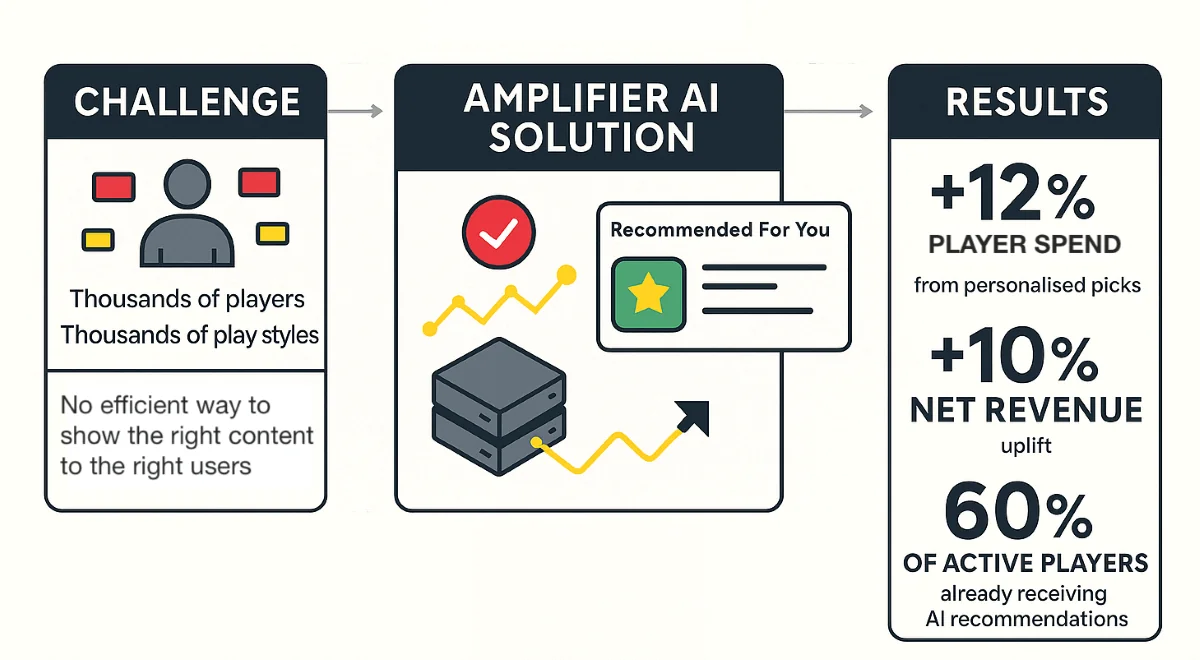
And again, this isn’t just theory. One of the examples is the Buzz Bingo and Future Anthem partnership, which you can see summarized in this quick infographic below:
Detect Fraud, Bonus Abuse, and Duplicate Accounts
Fraudsters constantly try new tricks: they spin up multiple accounts, drain bonuses, and hijack player profiles. Obviously, catching them manually hasn’t been working out for a long ago.
Now, it’s AI police that catches fraudsters: predictive models track suspicious behavior and unusual patterns like impossible navigation or onboarding anomalies that usually indicate duplicate accounts.
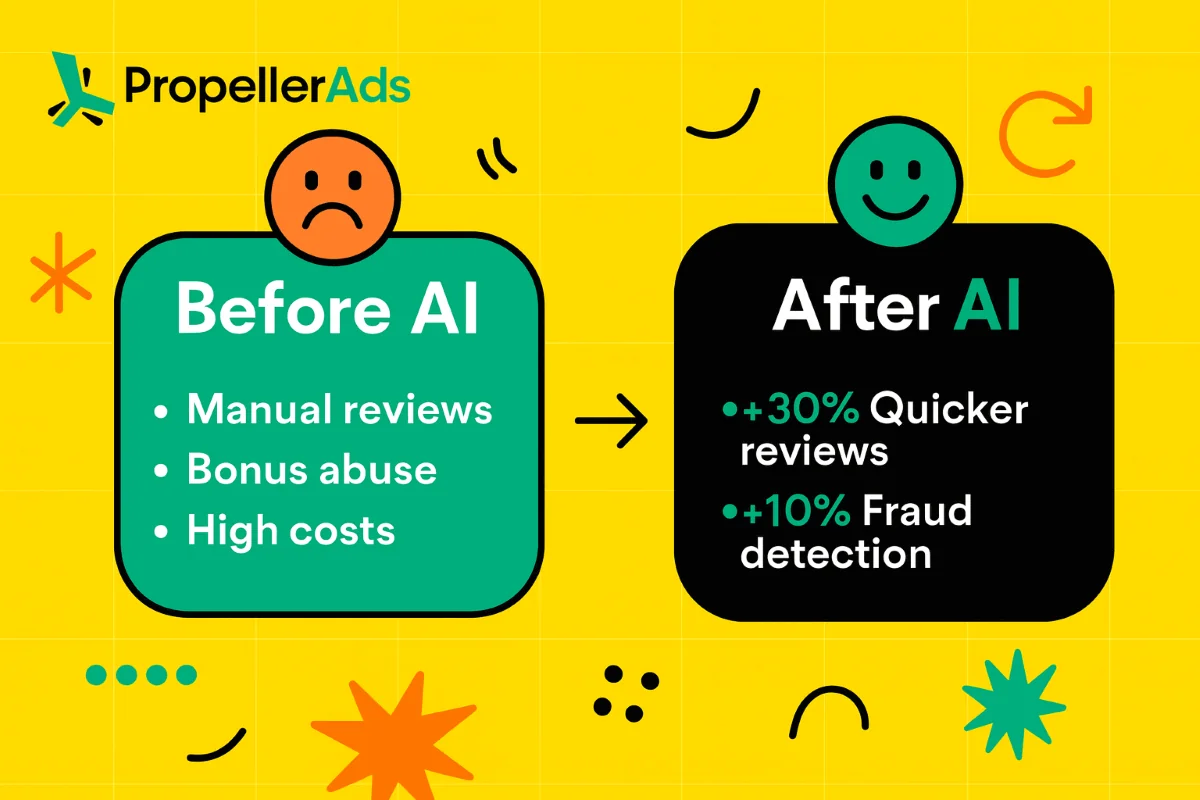
A good example is LeoVegas, an iGaming brand. Before using an AI-based system, their fraud team was overwhelmed with manual reviews, bonus abuse was on the rise, and operational costs continued to climb. After integrating SEON’s AI, everything sped up:
How Does It Affect Media Buyers?
Okay, that’s exciting research. But what about the part where it gets interesting for media buyers who drive iGaming traffic? Here it is:
AI isn’t just changing how operators work. The whole chain: click → registration → deposit → redeposit becomes far more predictable, and it leads to big shifts a media buyer might notice.
Of course, these are still speculations based on early forecasts – partly from our analysis, partly from insights shared by several media buyers who preferred to stay anonymous. But the patterns repeat often enough that it’s hard to ignore where things seem to be heading.

ROI Will Rise (But Drop for Some)
AI helps brands re-engage players more effectively: it pushes relevant games, bonuses, and nudges at the right moment. It means each depositing user becomes more valuable.
At the same moment, AI gets much stricter with risky segments like multi-accounts, suspicious VPN users, etc, it filters them out almost instantly. As a result, such low-quality traffic simply disappears from the funnel. And, if you are into such schemes, your CRs might also significantly drop.
To sum up: the ROI goes up for clean traffic but may drop for buyers who relied on abusive flows that AI now blocks instantly.
Traffic Checks Will Tighten
Brands have been evaluating traffic quality for years, and the FTD number alone has never been enough. With AI, checking this quality becomes much easier because the system can automatically track and even predict retention. It can see how likely each player is to stay active, come back, or make another deposit. So it’s pretty natural for brands to turn this into new KPIs.
For example, we can expect new metrics like a 7-day retention rate or a re-deposit share – the KPIs that will bring better payouts, but will imply more struggle.
To sum up: media buyers will need even more high-quality users than ever to stay competitive.
![65K Conversions for Chinese iGaming Advertiser [Case Study]](https://propellerads.com/blog/wp-content/uploads/2025/02/PropellerAds-65k-Conversions-for-Chinese-iGaming-Advertiser.jpg)
Offers Will Compete Harder
Yes, buyers expect things to heat up. When each player becomes more valuable, operators start competing more aggressively for good traffic. To attract affiliates, they will try to make their offers look better – with higher payouts, faster tests, and more focus on GEOs that convert well.
To sum up: media buyers with clean, stable traffic will earn more and get better offers.
Deeper personalization requires collecting more player data. The more data operators handle, the stricter the privacy rules they must follow. What does this mean for media buyers?
Imagine you’re sending traffic to an iGaming brand, and earlier you could roughly see what’s happening: who came in, who dropped off, who deposited. Not every detail, but at least a basic understanding.
Now AI is looking at every player, scores them, blocks some, keeps others, and you don’t see why. So it’s like – ‘this one passed – this one didn’t – but we won’t tell you why, okay?’
To sum up: you know the result, but you don’t get the explanation behind it.

Final Words
The AI iGaming future seems fairly clear: those who already send clean, high-quality traffic will likely benefit the most, as their players will stay longer, bring more value, and brands will compete harder for this traffic.
Those who rely on tricks, loopholes, or grey methods will feel the squeeze, as AI will block this kind of traffic much quicker.
So, the gap between high and low quality traffic will most likely feel bigger ,but without a dramatic change in how the whole system works.
Join our Telegram for more insights and share your ideas with fellow-affiliates!