How to Make Clicks Convert: What Really Makes Ads Work

We think that every advertiser knows the pain of a campaign that gets tons of clicks… and almost no sales or leads. And that’s exactly why understanding how to make clicks to convert is the difference between just having traffic (even super high-quality) and earning real profit.
So before we talk about tricks or hacks, let’s look at what actually makes people not only click, but follow through and complete the action you’re paying for.
Clicks and Conversions Start With the Right Intent
To begin with, most conversion problems don’t start on the landing page, but earlier – in the ad itself. If your ad promises one thing and your page delivers another, users feel tricked and bounce.
So instead of asking “How do I get more clicks?”, a better question is “How do I attract the right click from the right person at the right moment?” That shift alone already moves you closer to how to make clicks to convert.
Here are three intent killers you’ll want to fix right away:
- Overpromising creatives that don’t entirely match the offer
- Too broad targeting that pulls in curiosity clicks, not buyers
- One-size-fits-all messaging for all funnel stages
By aligning your ad promise, your target audience, and your funnel stage, you make every click more “pre-qualified” before they even land. And that’s why the cheapest click is not always the most profitable – the best click is the one that comes with clear intent to act.
How to Make Clicks Convert Using Color Psychology and Emotional Triggers
To move a bit deeper, let’s talk about what happens in those 1-2 seconds when a user sees your creative. This is where color psychology and emotional triggers quietly decide whether they stop scrolling or keep going.
Instead of randomly picking colors that “look nice”, treat your palette as a tiny emotional script. For example, blue often feels safe and trustworthy (great for finance, SaaS, B2B), while red can create urgency or excitement (perfect for limited-time offers and flash sales). And when you mix that with emotional triggers like fear of missing out, curiosity, or relief, you build ads that feel more relevant.
Think about these emotional angles:
- Relief: “Finally solve this annoying problem.”
- Aspiration: “People like you are already getting this result.”
- Urgency: “Spots are closing today.”
- Belonging: “Join others in your situation.”
By consciously combining Color psychology and emotional triggers, you’re not just asking people to click – you’re making them feel like clicking is the natural next step. And that emotional alignment is why the same offer can flop with one creative and crush it with another.
Storytelling, Microcopy, and UX in Ads: Smoothing the Path to Conversion
To keep things moving, let’s follow the user after the click, because this is where many campaigns silently die. Once someone lands on your page, their brain is asking: “Is this what I expected? Is this easy? Is this safe?” and UX in ads becomes just as important as UX on the landing itself.
This is where storytelling and microcopy come in. Storytelling is about showing a tiny, relatable transformation – a “before” and “after” in just a few lines. Microcopy is everything small: button labels, hints, labels on form fields. Together, they can do both: calm the user down or confuse them.
Here’s how they all work together in practice:
- The ad tells a mini-story: “Before: wasting hours doing X. After: solve it in 5 minutes.”
- The landing continues the same story: same visuals, same wording, same promise. And details, of course, that really support the initial claim – that’s important.
- Microcopy answers silent objections: “No credit card required”, “Cancel anytime”, “Takes 2 minutes”.
When your story, microcopy, and UX in ads and landing are consistent, users never feel like they’re jumping between different promises. And that sense of continuity is exactly what makes your “how to make clicks to convert” strategy feel smooth instead of forced.
Before/After Creative Example: Small Tweaks, Big Results
To make it more concrete, let’s walk through a simple before-after creative case study you can almost copy into your own campaigns. Even if the numbers are hypothetical, the pattern is very real for affiliate marketers and brands.
Before:
A generic banner for a VPN offer: “Fast & Secure VPN. Get Started.” Blue background, logo, and a “Learn More” button. The CTR is decent – people do care about VPNs – but the conversion rate is low. Users click, look around, and leave.

What’s wrong?
- No specific emotional trigger (everyone says “fast and secure”)
- No clear story (who is this for, and why now?)
- Weak microcopy (“Learn more” feels like extra work, not a benefit)
After:
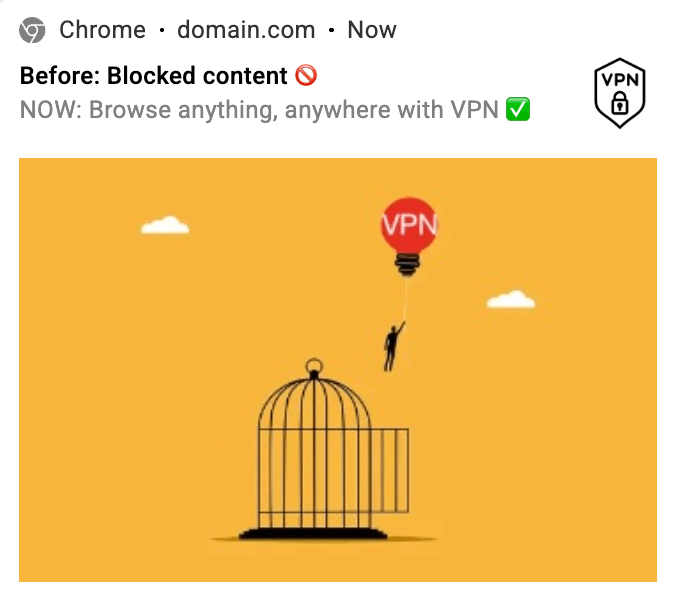
The same VPN but reframed: a broken cage and freed user, sign “Before: Blocked content. After: Browse anything, anywhere.” You can also play with wordings like “Unlock My Access”, and small lines like “30-day money-back guarantee”.
What changed?
- Emotional trigger: frustration → freedom (content you want to access)
- Storytelling: clear before/after in one line
- Microcopy (optional): benefit-driven
By changing only the creative and microcopy, you might keep a similar CTR but see a potential lift in conversion rate. And that’s the kind of win that proves you’re not just buying traffic – you’ve learned how to make clicks to convert with intention.
Practical Checklist: How to Make Clicks Convert
To tie everything together, it helps to have a quick checklist you can run through before launching or optimizing your next campaign. This way, you’re not guessing – you’re checking each lever that impacts conversions.
Ask yourself:
- Is the promise in my ad exactly aligned with the first screen of the landing?
- What emotional trigger am I using, and is my color psychology supporting it?
- Does my storytelling create a clear before-after in one or two lines?
- Is my microcopy removing friction and fear instead of adding confusion?
If you can honestly say “yes” to most of these, you’re already miles ahead of random click-chasing. And once you start thinking this way, every A/B test becomes less about “new banner vs old banner” and more about “better emotional fit vs worse emotional fit”, which is how the pros optimize.
Final Thoughts: Turning Clicks into a Conversion Habit
To wrap it up, clicks are still important – they’re the front door to your funnel – but they’re not the finish line. When you focus on how to make clicks to convert, you stop obsessing over cheap traffic and start designing experiences that actually pay you back.
So next time you launch a campaign on PropellerAds or any other platform, don’t just ask, “Will people click this?” Ask instead, “Will the right people feel guided all the way to the conversion?” Because once you build that habit of aligning intent, color psychology, emotional triggers, storytelling, microcopy, and UX in ads, you won’t just get more clicks – you’ll finally get the conversions you’ve been paying for all along.
Join our Telegram for more insights and share your ideas with fellow-affiliates!