Navigating the Financial Landscape of Affiliate Marketing: Income vs. Expenses

When it comes to money, you don’t guess, you calculate.
And in affiliate marketing, income vs expenses is a numbers game. Play it right and you scale. Get sloppy, and you sponsor your competitors’ growth.
From PropellerAds’ side of the table, here’s how you model, optimize, and win.
Start with the revenue reality (not hype)
Affiliate programs pay on CPA/CPS. Typical commission ranges are between 5–30% depending on the vertical. Direct-to-Consumer (DTC) brands often start around 10–15% per new customer order.
But that’s the ceiling. Your actual affiliate marketing income depends on traffic volume, conversion rate, and average order value (AOV). Plus, how often those buyers return (LTV).
Industry-wide, affiliates’ role in commerce is big and growing. U.S. spending hit the mid-teens (billions) and keeps rising, while affiliates drove ~20% of U.S. Cyber Monday 2024 eCommerce revenue.
And those affiliate-linked products were 6 times more likely to convert than non-affiliate content. Translation: the channel moves the needle.
Surveys vary, but reputable roundups show that affiliate marketing income potential spans widely.
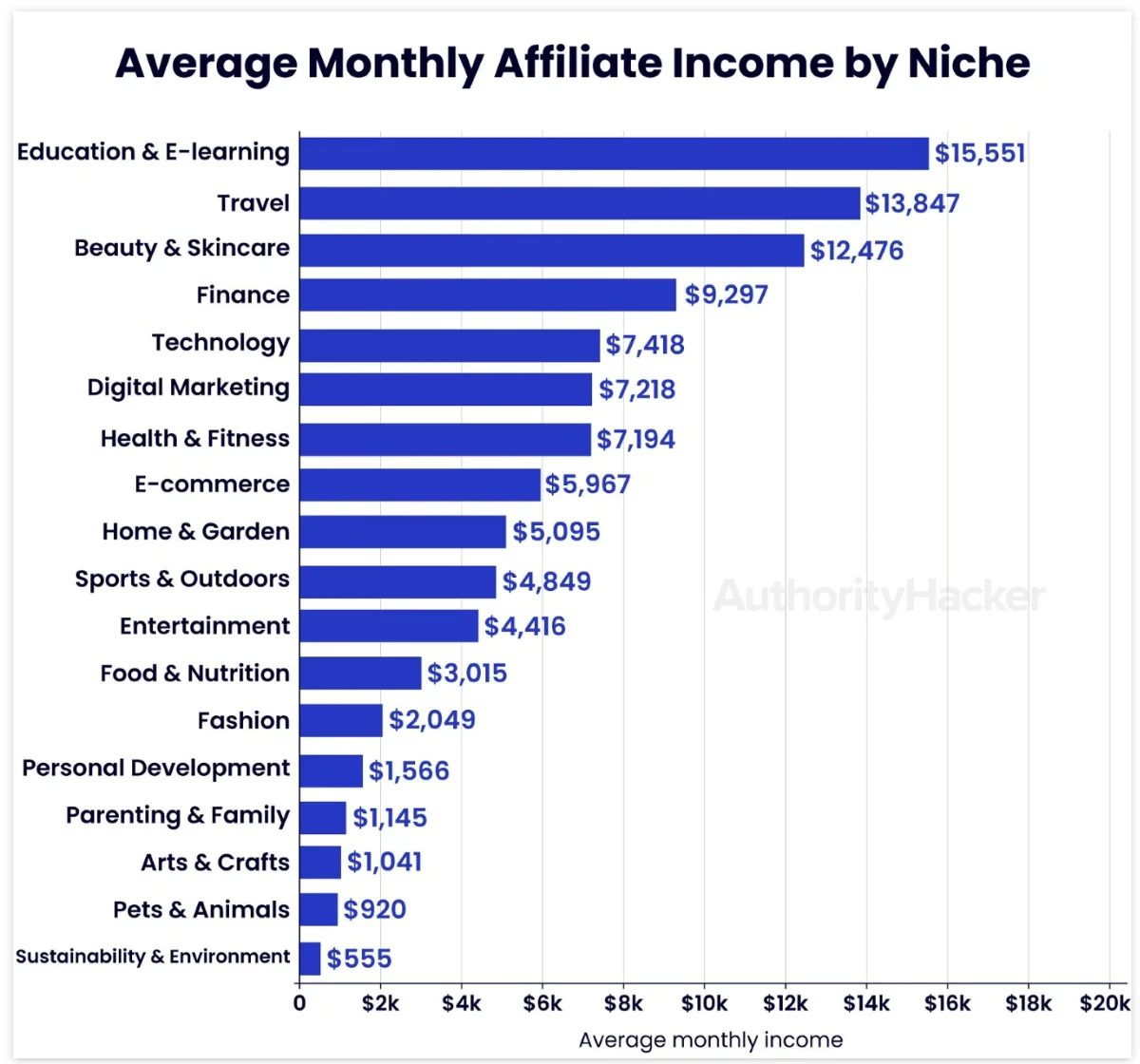
Image Source: Ahrefs
While many earn modestly, a meaningful minority report high five to six figures. A clear proof that execution, not the model, sets the cap.
Now, map the cost stack
Your Profit and Loss (P&L) lives and dies on acquisition costs. So, if you buy traffic, benchmark it. Recent data puts typical Google Ads CPCs around a few dollars and display below a dollar.
While you average Cost Per Lead across search in 2024 clocked in around the mid $60s (varies by industry). Use these as sanity checks when planning.
The reality looks pretty different, with an average CPC across different display mediums of ~$1.52:
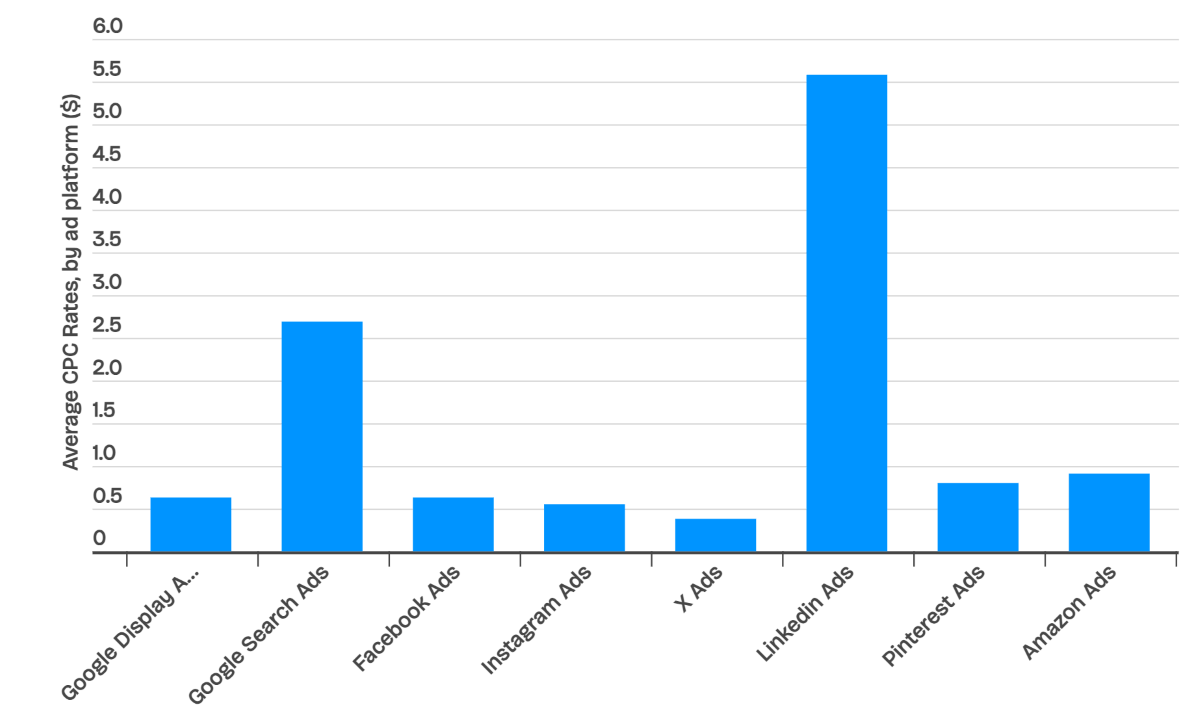
Image Source: Business of Apps
But media’s not everything. Keep in mind to leave some budget for:
- Tracking & tools: attribution, link management, landing page/offer testing.
- Creative ops: ad production (video, UGC, banners), translators, compliance review.
- Compliance time: FTC-compliant disclosures on every affiliate touchpoint, or similar EU-wide laws enforced by national authorities.
The only formula that matters
Memorize this:
Profit = (Traffic × CTR × CVR × AOV × Commission%) − (Traffic × CPC) − Fixed Costs
Where CVR is Conversion Rate, and AOV is the Average Order Value, or the average money spent per completed order.
Or, if you buy on CPA:
Profit = (Conversions × Payout) − (Conversions × CPA) − Fixed Costs
However, we need to talk in terms of LTV:CAC, or the ratio of your customer Lifetime Value (LTV) to your Customer Acquisition Cost (CAC).
Your target is a defensible LTV:CAC ≥ 3:1 (stricter for thin-margin niches). If you’re sub-3:1, you either need a higher payout/commission, a better converting funnel, or cheaper traffic.

Affiliate Marketing Passive Income: Truth or Myth?
When speaking of affiliate marketing, passive doesn’t mean hands-off. It’s real, but it means compounding. In other words, you build assets that keep converting:
- Content that ranks and refreshes itself via internal linking and periodic updates
- High-intent formats: comparisons, “best X for Y,” calculators
- Email flows and push subscriptions to re-activate undecideds
That’s how affiliate marketing passive income becomes real. You front-load the work and let evergreen pages and owned audiences deliver ongoing affiliate marketer income. Without paying the ad tax every time.
Where PropellerAds fits (and why it matters)
You want consistent, scalable traffic that converts on affiliate offers. And that’s exactly our lane.
We provide performance inventory at scale. We’re talking global reach with formats built for affiliate funnels (Push, In-Page Push, Interstitials, Popunder, Survey Exit, and Telegram Mini App Ads). So, you buy intent, not just impressions.
Next up is our granular targeting. Whether it’s OS, Geo, Carrier, Zone IDs, User Interests, or Frequency. You can be sure to tighten your spending around the pockets that convert.
With PropellerAds, you can launch with brisk testing budgets and 3–5 creatives per segment. And our optimization tools auto-route spend toward the best zones. All while you A/B your prelanders and angles.
Moreover, you get conversion-based optimization, pass postbacks. This means that we learn from real conversions (not just clicks). That’s how you lower eCPA and keep affiliate marketing average income trending up while expenses stay in check.
Lastly, you get to partner with a brand-safe and compliant network.
Your 7-day profit playbook
Day 1–2: Benchmark & brief
- Pick 1–2 offers with transparent payouts aligned to your AOV and funnel economics. Forget about guessing EPCs, think in eCPA. You want your acquisition cost sitting comfortably below your payout so you’re in profit territory from the first test.
- Define your KPIs: eCPA target, CVR targets by step, ROAS floor.
Day 3–4: Launch smart
- Create two prelanders (short/long), three headlines, and two hero images.
- Start with Push + Interstitials across 3–5 geos; cap frequency; separate new/retargeting.
Day 5: Attribute & cut
- Pass S2S postbacks; check zone-level ROAS.
- Kill the bottom 20–30% of zones; raise bids on the top quartile.
Day 6: Iterate creative & funnel
- Duplicate winners; test one new angle (social proof, urgency, bonus).
- Improve load speed and form friction—micro-wins lift affiliate marketing income fast.
Day 7: Scale with control
- Expand Geos/OS; keep your LTV:CAC in range.
- Reinvest a fixed share of profit into content/SEO to compound affiliate marketing for passive income.
In Conclusion: Managing Expectations
Yes, the average income for affiliate marketing is uneven. And that’s fine. Markets pay the operators who measure.
With tight benchmarks (commissions 5–30%, CPC/CPL sanity checks), compliant disclosures, and a testing rhythm, your affiliate marketing income potential is meaningful and repeatable.
Run the math, not the myths: control eCPA, lift CVR × AOV, and turn affiliate marketing income vs expenses into profit.
With PropellerAds, you test, cut, and scale. Until performance compounds.
Ready to get started?
Join our Telegram for more insights and share your ideas with fellow-affiliates!